The numbers in one place
- 1,009,615 spins across two accounts; A$31.26 million staked, A$29.96 million paid back. Realised return 95.8%, net loss A$1.30 million.
- 7 in 10 spins returned nothing. About 1 in 10 returned more than the stake.
- Biggest single spin: A$144,550 from a A$70 bet (2,065×). The account that won it finished fourteen months at A$0.14.
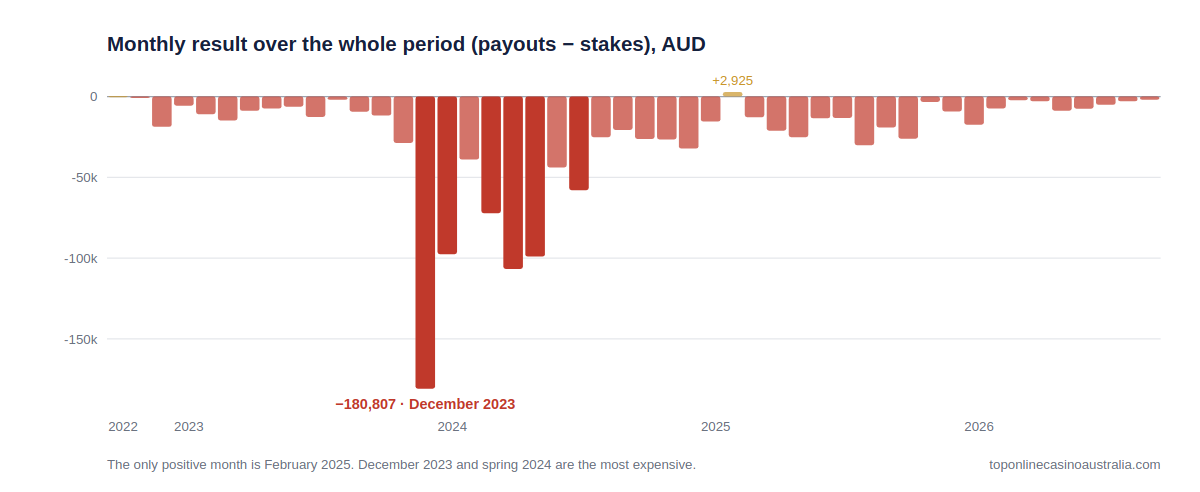
- 1 positive month out of 48 for the longer account: February 2025, +A$2,925. The worst month cost A$180,807.
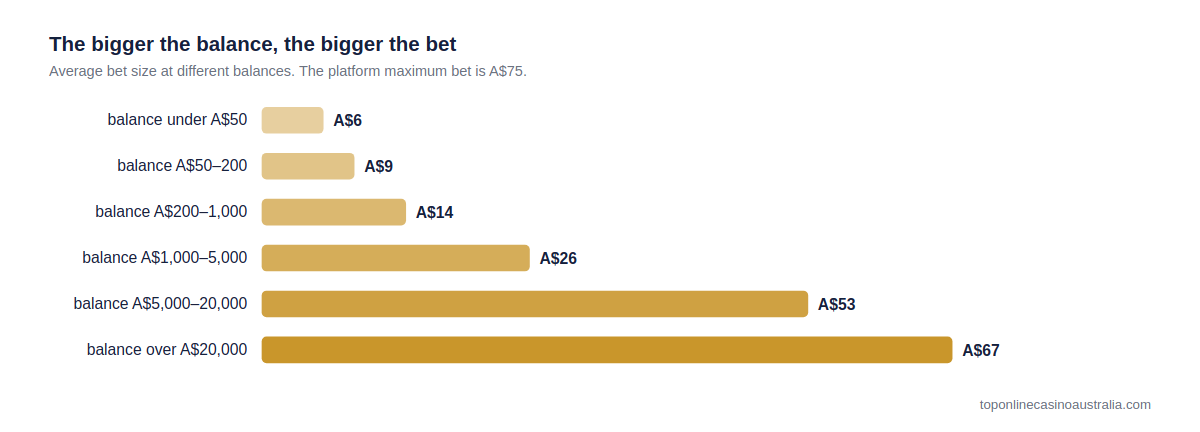
- Bets grew with the balance: an average of A$6 a spin with under A$50 in the account, A$67 a spin with over A$20,000. The bet after a losing spin (A$27.6) was the same as after a winning one (A$27.7).
Where the numbers come from
Two accounts, two exports of the operator's own bet log: one row per spin, with time, game, stake, payout and balance after the round. The first account played 156,168 spins over fourteen months (July 2025 to September 2026), the second 853,447 spins over four and a half years (April 2022 to September 2026). Both played at the same platform ceiling of A$75 a spin, both favoured the same family of games (fishing and hold-and-win titles such as Big Catch Bonanza, Blast the Bass, 15 Dragon Pearls and Elvis Frog in Vegas), and both ended with a few cents in the account.
| Account | Spins | Staked | Paid back | Return | Net |
|---|---|---|---|---|---|
| Gold Power Express | 156,168 | A$7.69m | A$7.60m | 98.8% | −A$92,027 |
| Three days on top | 853,447 | A$23.57m | A$22.36m | 94.9% | −A$1.21m |
| Both | 1,009,615 | A$31.26m | A$29.96m | 95.8% | −A$1.30m |
The players are anonymised and cannot be identified from anything we publish; how the exports were handled is described on the series page. The aggregated data behind every chart is downloadable as CSV from each story.
How pokies actually pay out
A pokie does not pay out a little on most spins. It pays nothing on most spins and a great deal on very few. In the longer log, seven spins in ten returned zero, two in ten returned less than the stake, and roughly one in ten returned more than the stake. The published return-to-player figure for these games, typically 95 to 97 per cent, is an average over millions of spins; it says nothing about what any hour will look like.
What an hour looks like is in the balance charts. On 3 June 2026 the first account went 207 consecutive spins without a single payout, nine minutes at A$60 a spin, and A$12,500 became nothing. An hour later Billy Bob Boom paid A$29,000 on one spin. Both are ordinary behaviour for a high-volatility game. The player switched games five times during the dry streak; the dry streak did not care.
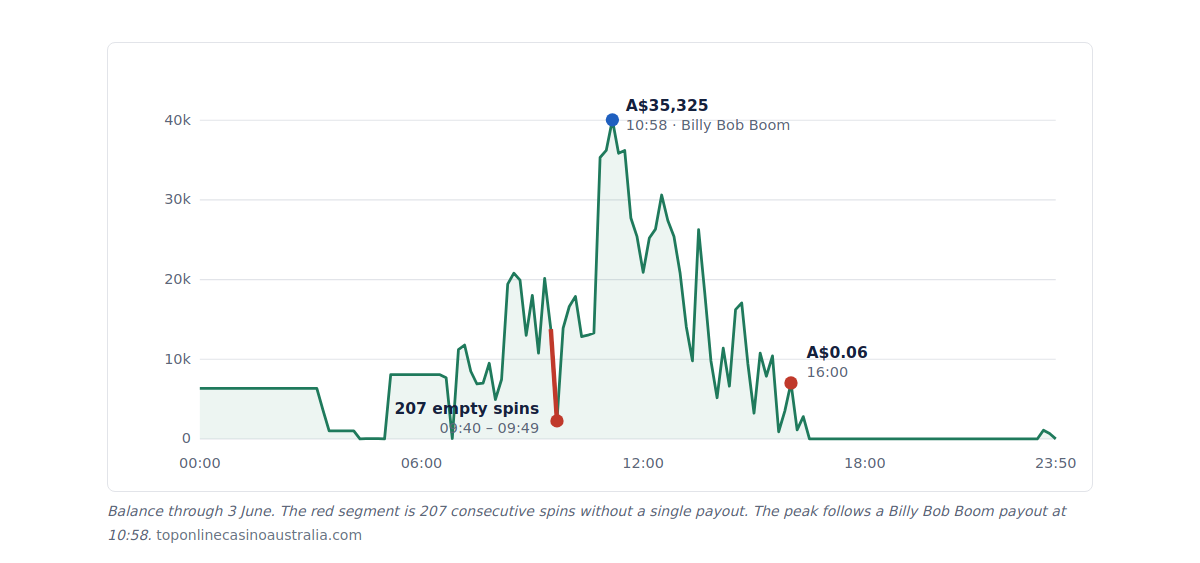
The wins, when they come, are big enough to feel like a change of fortune. The longer log has four separate spins above A$50,000, each on a A$40 to A$75 bet, each a multiplier past 1,000×. The shorter one has a 2,065× spin. That is the design: the rare enormous payout is what the seventy per cent of empty spins are paying for.
Can you win on pokies: a day, a month, a year
Yes, no and no, in that order, and the logs put numbers on each.
A day. The first account had two days that closed more than A$80,000 up: 1 August 2025 (+A$81,530) and 23 May 2026 (+A$112,239). Out of 57 playing days, 13 closed in profit. The second account's best day closed at A$118,413 after starting from A$508.
A month. The longer log covers 48 months with play. One of them closed in profit, February 2025, by A$2,925. The other 47 lost money, from a few hundred dollars to A$180,807 in December 2023.
A year. Neither account had one. The first lost A$92,027 in fourteen months on the back of a A$144,550 single spin; the second lost between A$19,000 and A$647,000 every calendar year it played.
The pattern behind this is simple and it is the same in both logs: a big win does not leave the account. On 23 May 2026 the first player had A$160,050 at 14:09 and kept playing until 00:48; the day still closed as the best in the log, but at A$88,177, not A$160,000. Over the next fortnight the balance went above A$100,000 twice more and to zero twice more. Across the whole fourteen months the account took in about A$951,600 in deposits and paid out about A$850,200 in withdrawals: the winnings were withdrawn, then deposited again, then staked again. The second account deposited roughly A$1.49 million and withdrew A$307,000.
What “strategies” look like in a real log
Neither player followed a betting system in the textbook sense. What they did follow, without apparently deciding to, shows up clearly in the data.
The bet follows the balance. In the longer log the average stake was A$6 with under A$50 in the account, A$14 with A$200 to A$1,000, A$53 with A$5,000 to A$20,000 and A$67 above that. The correlation between balance before a spin and the size of the bet is 0.58. A win does not get banked; it raises the stake, which raises the turnover, which raises the expected loss.
No reaction to losing. The stake after a losing spin averaged A$27.6; after a winning spin, A$27.7. There is no martingale, no doubling to chase, no caution after a hit. This is worth knowing because it removes the usual explanation for big losses. The losses did not come from tilt. They came from volume.
Volume. The first player's median pause between spins was 2.3 seconds, and the longest session ran fourteen hours without a break. At A$75 a spin and 1,500 spins an hour, turnover is A$112,000 an hour. At a 96 per cent return the expected loss on that hour is about A$4,500. Nothing else on this page matters as much as that arithmetic.
Switching games. The first player used 337 different pokies in fourteen months; the second used 59, with four of them taking three quarters of all spins. Switching did not change anything measurable. The two best games in the first log (Blast the Bass, Gold Power Express) returned A$302,000 net; the other 335 lost A$394,000. That is not because those two games are generous. It is where the two biggest spins happened to land.
Topping up. The second account made around 4,000 deposits with a median of A$250, including 36 on a single day, 9 May 2024. Small, frequent deposits are how A$1.49 million enters an account without ever feeling like A$1.49 million.
Are online pokies rigged: what the logs can and cannot show
A bet log cannot audit a random number generator. It can check whether the money that went in and came out is consistent with the return the games advertise, and whether the results after a big win look different from the results before it.
Return. The two accounts realised 98.8 per cent and 94.9 per cent of turnover, 95.8 per cent combined. Published returns for the games they played sit in the mid-nineties. A million spins is enough for the average to settle, and it settled where the operator said it would. This is also the answer to why they lost so much while the return was so high: 4.2 per cent of A$31 million is A$1.3 million.
After a big win. The suspicion that a game “tightens” after paying out is easy to test. After the A$144,550 spin on 23 May 2026 the same account won A$71,135 on one spin two days later, A$42,840 five days later and A$46,100 a fortnight later. After the A$79,950 spin on 10 May 2024 the second account won A$78,225 a week later. The big wins were not followed by unusually bad stretches; they were followed by the same 70 per cent of empty spins as before, on bigger stakes.
What the logs cannot show. Whether a specific game's actual return matches its certificate, whether the operator is licensed, or whether withdrawals are paid. Those are separate questions; we cover licensing and payout speed in the casino reviews and in withdrawal times.
The five things that actually change the result
Everything in the two logs points at the same short list. None of it makes pokies profitable; it decides how quickly and how much you lose, and whether a win ever leaves the account.
- Stake times spins. Expected loss is turnover multiplied by the house edge. Halving the stake or the session halves it. The two accounts staked A$31 million to lose A$1.3 million; the same games at A$1 a spin would have needed 31 million spins to do the same damage.
- Withdraw when ahead, and do not redeposit. The only money that stayed with either player was the A$72,000 the second one withdrew on 23 December 2023. Every other six-figure balance went back in. A withdrawal that is redeposited the next day is not a withdrawal.
- Published return matters, a little. A 97 per cent game loses a third less than a 95.5 per cent game over the same turnover. It does not change the sign. Our list of highest-return pokies gives the certified figures.
- Bonuses with wagering conditions add turnover. A bonus that must be wagered 40 times is 40 times its value in extra spins at the house edge. The terms explained page shows how to price one.
- Limits set before the session, not during it. Deposit limits, session timers and self-exclusion tools are the only things in this list that work against the pattern the logs show, because the pattern is that decisions made with A$100,000 in the account are worse than decisions made with A$100. Our support resources page lists what each Australian bank and each operator offers.
Questions people ask
Is there a strategy to win on pokies?
Not one that changes the expected result. Each spin is independent and pays on average less than it costs. A million real spins across two accounts returned 95.8 per cent of what was staked, exactly where the advertised returns put it, regardless of stake size, game choice or how the players behaved after wins or losses. What a strategy can change is turnover: smaller stakes and shorter sessions lose less, and withdrawing a win instead of redepositing it is the only way a win is kept.
Do pokies pay more at certain times of day?
Nothing in the logs suggests it. The biggest wins in the two accounts landed at 14:09, 17:09, 22:50 and 10:58 on different days; the biggest losses were spread the same way. Online pokies use a random number generator that does not know what time it is.
Does switching games after a losing streak help?
No. The first player switched games five times during a 207-spin losing streak and the streak continued. Over fourteen months that player used 337 different pokies; the result was decided by two spins, not by which game was open at the time.
Is a big win due after a long losing streak?
No. Streaks are not tracked by the game. The 207 empty spins on 3 June 2026 were followed by a A$29,000 spin an hour later, but the A$144,550 spin on 23 May came after an ordinary morning with no notable streak at all. The two are unrelated.
Do online pokies pay better than pub pokies?
Usually, by the published numbers. Australian state rules set minimum returns for club and hotel machines of roughly 85 to 87 per cent depending on the state, and many venue machines sit near the minimum. Online games from the major studios are certified at 94 to 97 per cent, and the two logs realised 94.9 and 98.8 per cent. A higher return means a slower loss, not a profit, and online play makes it far easier to stake A$75 every 2.3 seconds for fourteen hours.
How much do pokies players actually lose?
It depends almost entirely on stake and time. The two accounts here lost A$92,027 in fourteen months and A$1.21 million in four and a half years, at the platform maximum of A$75 a spin. At the same return, someone staking A$1 a spin for an hour a week would expect to lose in the region of A$3 to A$4 a week. The percentage is the same; the volume is not.
What should I do if pokies have stopped being entertainment?
Free, confidential help is available 24/7 from the National Gambling Helpline on 1800 858 858 and at gamblinghelponline.org.au. Deposit limits and self-exclusion with each operator, a gambling block in your banking app and a device-level blocker are described on our support resources page.
18+. Gambling involves real financial risk. This page describes what two real bet logs contain. It is not a method for winning: both accounts it is based on lost money, and the patterns described here are the reasons why.
Sources and method
Two operator bet-log exports (156,168 and 853,447 rows, AUD), analysed spin by spin; the full narratives are A$70 on Gold Power Express and Three days on top, and the aggregated data files (results by day and month, balance by the hour, bet-size distribution, net result by game) are linked from each story and from the series page. Player result = payouts − stakes. Deposits and withdrawals are reconstructed from balance gaps and are estimates. Return percentages are payouts divided by stakes over the whole period. The share of spins returning nothing, less than the stake, and more than the stake is from the longer log. Expected-loss figures use the arithmetic stated in the text and a 96 per cent return; venue minimum returns are from state gaming regulations and vary by jurisdiction.