Roulette is the easiest casino table game to learn and one of the easiest to misunderstand. A wheel, a ball, 37 numbered pockets, and a betting layout that lets you back anything from a single number to half the wheel. There is no decision that improves your odds once the ball is spinning, which is exactly why the choices you make beforehand matter: which wheel, which rules, which bets and how fast you play.
This guide covers all of it in plain language: how online roulette works, every bet and payout, the real house edge of each variant, why betting systems fail, how live dealer and RNG tables differ, and where the law stands for Australian players in 2026.
Roulette in 60 seconds
- Pick single-zero wheels. European roulette costs 2.70% of turnover on average; American double-zero costs 5.26%, almost twice as much for the same game.
- French rules are the best on offer. With La Partage, even-money bets lose only half on zero, cutting the edge to 1.35%.
- Every standard bet on one wheel has the same edge. A straight-up number and a bet on red are equally “good”. They differ in volatility, not in value.
- No staking system changes the maths. Martingale and its cousins reshape wins and losses; they never remove the house edge.
- Speed is the hidden cost. A fast RNG table can run four times as many spins per hour as a live table, and cost four times as much.
- Legal position: offering online casino games to people in Australia is prohibited under the Interactive Gambling Act 2001. Details below.
Is online roulette legal in Australia?
The short version: you can legally play roulette in a licensed Australian casino, but no company may legally offer you real-money online roulette. The Interactive Gambling Act 2001 (IGA) prohibits providing online casino-style games, including roulette, blackjack and pokies, to anyone physically in Australia. The offence sits with the operator and its advertisers, not with the individual player, a 2011 federal review paper of the Act says. There is no such thing as an Australian-licensed online casino, so every site that takes Australian customers for roulette is based offshore.
That has practical consequences. The Australian Communications and Media Authority (ACMA) investigates illegal services and asks internet providers to block them, which is why offshore casino domains disappear and reappear under new addresses. If an offshore site delays or refuses a withdrawal, there is no Australian regulator, ombudsman or court process that can realistically get the money back. BetStop, the National Self-Exclusion Register, covers licensed Australian wagering services only, so it does not block offshore casinos.
What changes on 1 January 2027
Parliament passed the Interactive Gambling Amendment (Gambling Reform) Act 2026 in August 2026, with most measures commencing on 1 January 2027. Along with broad restrictions on wagering advertising, the reforms strengthen enforcement against what ACMA calls illegal gambling services, including powers to take down those services and their advertising, and new obligations on banks and payment providers to take reasonable steps to stop payments to them. Expect deposits to and withdrawals from offshore casinos to become less reliable.
Nothing on this page is legal advice, and nothing here is an invitation to use a service that is prohibited where you live. We explain how the game works so that anyone who plays, online or on a casino floor, understands exactly what they are paying for. For a wider view, see our guides to gambling in Australia and casino games.
Where Australians actually play online roulette for real money
None of these operators holds an Australian licence — the legal section above explains why none can. What follows is not a recommendation to sign up, it is what we could see in each lobby, checked from an Australian address on 19 September 2026. Where a lobby would not show its tables without an account, we say so rather than guess.
If you want to play roulette online for real money from Australia, the lobbies below are the ones we opened ourselves rather than took on trust. Every one of them also runs free online roulette in demo mode, so the layout, call bets and table speed can be checked with play credits before any deposit; the same maths applies at both.
| Casino | Roulette tables seen in the lobby (19 Sep 2026) | Live dealer | Our rating |
|---|---|---|---|
| Casinonic | European, French, American, Auto, Mini and Double Ball — the widest spread we could confirm | Yes — live roulette section | 7.8 / 10 |
| Ricky Casino | European, French, American, Auto, Mini and Double Ball | Yes — Evolution | 7.8 / 10 |
| King Billy | European, French, American, Auto, Mini and Instant Roulette | Yes — live dealer section | 7.5 / 10 |
| CasinoChan | European, French, American, Auto, Mini | Yes — Evolution | 7.8 / 10 |
| PlayAmo | European, French, American, Auto, Mini | Yes — Evolution | 7.8 / 10 |
| Woo Casino | European, French, American, Mini and XXXtreme Lightning | Yes — Evolution | 7.8 / 10 |
| National Casino | A live dealer section is advertised; the table list needs an account | Yes — live dealer section | 7.3 / 10 |
| Golden Crown | Roulette is named on the site, but the lobby would not list tables without an account | Not shown without an account | 8.0 / 10 |
Two readings of that table are worth spelling out. First, a French table in the list is the single most useful thing on it: La Partage halves the house edge on even-money bets to 1.35%, and every operator above that carries French roulette gives you a cheaper game than the American wheel sitting next to it. Second, the presence of Mini Roulette in almost every lobby is not a bonus — at roughly 7.69% it is the most expensive wheel in the room, and it is usually placed where a beginner will find it first.
What this table cannot tell you is how fast a withdrawal is paid or how a dispute ends, and those matter more than the number of wheels. Our ratings come from the operator’s own terms and cashier; the method is set out in our editorial approach.
How roulette works
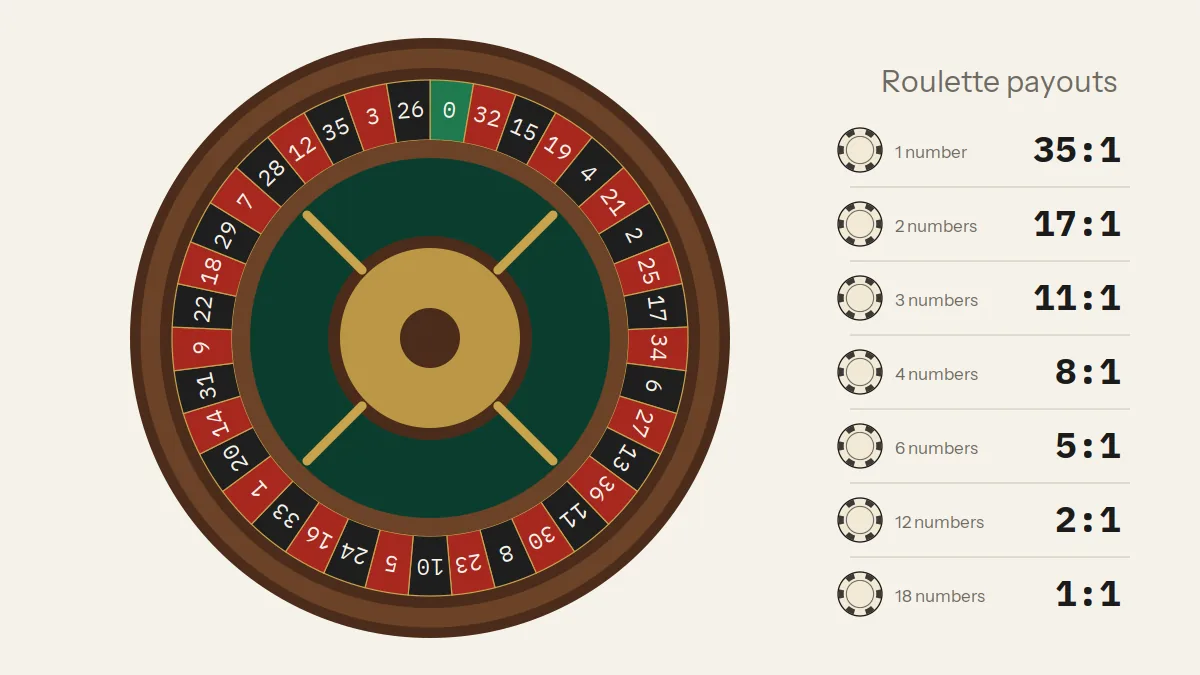
A European roulette wheel has 37 pockets: numbers 1 to 36, half red and half black, plus a single green zero. The dealer (or software) spins the wheel one way and sends the ball the other way around the track. The ball loses speed, drops, bounces off the diamond-shaped deflectors and settles in one pocket. Every pocket is the same size, so each number has the same 1 in 37 chance on every spin, regardless of what happened before.
A round of online roulette, step by step
- Choose a chip value. Online minimums commonly start around 10 cents on RNG tables and 50 cents to $1 on live tables. Check the table limits panel for both the minimum and the maximum per bet type.
- Place your bets. Tap the layout to drop chips on numbers, lines between numbers, or the outside boxes. You can combine as many bets as you like within the table limits.
- Betting closes. On a live table the dealer calls “no more bets” and a timer locks the layout. On an RNG table you press Spin.
- The result. The winning number is highlighted, losing chips are cleared and winning bets are paid according to the fixed payout table. Your original stake on a winning bet is returned with the winnings.
- Rebet, double or clear. The control bar lets you repeat the last bet, double it, undo a chip or wipe the layout. Treat Rebet with care: it makes it effortless to play faster than you planned.
That is the whole game. There is no skill element after the bet is placed, which puts roulette at the pure-chance end of the scale alongside online pokies and keno, and unlike blackjack or video poker, where decisions affect the return.
Roulette bets, odds and payouts
Bets fall into two families. Inside bets go on the number grid and cover one to six numbers. Outside bets go in the boxes around the grid and cover 12 or 18 numbers at once. The figure below shows where the chip sits for each one.
| Bet | Numbers covered | Payout | Win chance, European | Win chance, American |
|---|---|---|---|---|
| Straight up | 1 | 35:1 | 2.70% | 2.63% |
| Split | 2 | 17:1 | 5.41% | 5.26% |
| Street | 3 | 11:1 | 8.11% | 7.89% |
| Corner (square) | 4 | 8:1 | 10.81% | 10.53% |
| Five-number / basket (American only) | 5 | 6:1 | n/a | 13.16% |
| Six line (double street) | 6 | 5:1 | 16.22% | 15.79% |
| Column | 12 | 2:1 | 32.43% | 31.58% |
| Dozen | 12 | 2:1 | 32.43% | 31.58% |
| Red / Black | 18 | 1:1 | 48.65% | 47.37% |
| Odd / Even | 18 | 1:1 | 48.65% | 47.37% |
| Low 1–18 / High 19–36 | 18 | 1:1 | 48.65% | 47.37% |
“35:1” means a winning $1 chip returns $35 in winnings plus the original $1. Payouts are identical on European and American tables; only the number of pockets changes, which is why the same bet wins slightly less often on a double-zero wheel. For a deeper breakdown see our roulette payouts guide.
Which bets suit which player?
Because the edge is the same, bet choice is about the ride, not the price. Even-money bets win nearly half the time, so your balance moves gently and a fixed budget lasts a predictable number of spins. Straight-up bets lose 36 times out of 37 and then pay 35 to 1, so the balance falls steadily with occasional large jumps. A common middle path is one outside bet for steadiness plus one or two small inside bets for the chance of a bigger hit. None of these combinations is smarter than another; choose the pattern you find entertaining and can afford.
House edge, and why it never changes
Roulette payouts are set as if the wheel had 36 pockets. It has 37. That one extra pocket is the entire business model. Take a $1 straight-up bet on a European wheel: you win $35 once in 37 spins and lose $1 on the other 36, so on average you are down $1 per $37 staked. One divided by 37 is 2.70%. Run the same sum for a split, a dozen or red, and the answer is identical.
Add a second zero and the loss becomes $2 per $38 staked, or 5.26%. A third zero makes it 7.69%. Return to player (RTP) is simply the other side of the coin: 97.30% for European, 94.74% for American.
There are only two exceptions worth remembering. The American five-number bet (0, 00, 1, 2, 3) pays 6:1 when fair would be 6.6:1, giving it a 7.89% edge, the worst standard bet in roulette. And French rules improve even-money bets, as explained below.
Roulette variants compared
| Variant | Pockets | House edge | What is different |
|---|---|---|---|
| French roulette | 37 | 1.35% even-money, 2.70% other bets | La Partage or En Prison rule, French layout labels, call bets |
| European roulette | 37 | 2.70% | The standard single-zero game and the default choice |
| Live dealer roulette | 37 (usually) | 2.70% | Real wheel streamed from a studio, around one spin a minute |
| Auto live roulette | 37 | 2.70% | Real wheel with an automated ball launcher, no dealer, faster rounds |
| Lightning Roulette | 37 | 2.70% most bets, 2.90% straight-up | Random 50x–500x multipliers; straight-up pays 29:1 instead of 35:1 |
| Multi-wheel / multi-ball | 37 per wheel | 2.70% | One layout, several results per round; multiplies your stake per round |
| Immersive / Speed / Auto roulette | 37 | 2.70% | Presentation and pace only; Speed and Auto deal two to three times more spins per hour |
| Double Ball roulette | 37 | above 2.70% on the double-ball bets | Two balls; straight-up pays 17:1 instead of 35:1, both balls on one number pays 1300:1 |
| 3D / Premier roulette | 37 | 2.70% | Rendered wheel and a richer betting interface; rules unchanged |
| American roulette | 38 | 5.26% (7.89% five-number bet) | Adds 00. Same payouts, nearly double the cost |
| Mini Roulette | 13 | 7.69% (3.85% where half is returned on zero) | Numbers 0–12, straight-up pays 11:1 |
| Triple-zero roulette | 39 | 7.69% | Adds 000. No upside for the player at all |
La Partage and En Prison
These two French rules apply only to even-money bets (red/black, odd/even, low/high) when the ball lands on zero. Under La Partage you immediately get half your stake back. Under En Prison the whole stake is locked for the next spin: win and it is returned in full without winnings, lose and it is gone. Both roughly halve the edge on those bets to about 1.35%, the best value in any roulette game. If a table offers either rule and you like outside bets, it is the one to pick.
A note on language-specific tables
Live studios run the same European game with dealers speaking different languages, for example German, Turkish, Japanese or Russian-language tables. The rules, payouts and edge are identical to standard live European roulette; only the presentation changes. These tables have nothing to do with the dangerous “Russian roulette” of films, which is not a casino game.
Studio tables you will actually meet in an Australian lobby
Live lobbies are full of roulette tables with different names, and the marketing around them suggests the game itself changes. Almost none of it does. Two things move the maths — how many zeros are on the wheel, and whether La Partage or En Prison applies to even-money bets. Everything else on this list changes the presentation, the speed, or the size of the side bet. Speed is not nothing, though: a table that deals three times as many spins applies the same edge to your money three times as often.
Immersive Roulette (Evolution). A standard single-zero wheel — 37 pockets, house edge 2.70% — filmed with multiple cameras and slow-motion replays of the ball dropping. The production is the product. Nothing about the odds differs from plain European roulette, so pick it if you prefer the presentation, not because it pays better.
Speed Roulette and Auto Roulette. Same single-zero wheel, same 2.70%, with the dead time removed. A Speed Roulette round runs around 25 seconds against roughly a minute on a standard live table, and Auto Roulette drops the croupier entirely. Over an hour that is two to three times the number of spins, which means two to three times the expected loss at the same stake. If you play these, the sensible adjustment is a smaller unit, not the same one.
Double Ball Roulette (Evolution). The one table here that genuinely rewrites the payouts. Two balls are released on a single wheel, and the pay table is rebalanced for it: a straight-up number pays 17:1 rather than 35:1, because you win if either ball lands there, while a dedicated bet on both balls hitting the same number pays 1300:1. The headline multiplier is the attraction; the house edge on those double-ball bets is higher than on the plain game, and the 17:1 inside payout is what funds it.
3D Roulette (Playtech) and Premier Roulette (Microgaming). Single-zero games with the standard 2.70% edge and a rendered wheel instead of a streamed one. The difference is the graphics and the betting interface — customisable layouts, saved bets, statistics panels. Useful if you like the controls, irrelevant to the result.
Mini Roulette. Worth singling out because it is the exception that costs money. Thirteen pockets, zero through twelve, and a straight-up payout of 11:1. That combination puts the house edge at about 7.69% — nearly three times the European game. Where La Partage applies to the even-money bets it falls to about 3.85%, still worse than a normal table. A smaller wheel looks friendlier and is not.
The practical summary: if a table advertises a new name, check the pocket count and the straight-up payout before you accept that anything has changed. Our roulette payout chart lists every bet and what it returns, and the house edge section above explains where the difference actually comes from.
French call bets and the racetrack
Many online tables include a second, oval betting area called the racetrack. It mirrors the order of numbers on the wheel and lets you place call bets (also called announced bets), which cover a physical slice of the wheel with one tap.
| Bet | Numbers | Chips | How the chips are placed |
|---|---|---|---|
| Voisins du Zéro | 17 (22 round to 25) | 9 | 2 on the 0-2-3 trio, 1 each on splits 4/7, 12/15, 18/21, 19/22, 32/35, 2 on the 25-26-28-29 corner |
| Tiers du Cylindre | 12 (27 round to 33) | 6 | 1 each on splits 5/8, 10/11, 13/16, 23/24, 27/30, 33/36 |
| Orphelins | 8 | 5 | 1 straight on 1, 1 each on splits 6/9, 14/17, 17/20, 31/34 |
| Jeu Zéro | 7 (12 round to 15) | 4 | 1 straight on 26, 1 each on splits 0/3, 12/15, 32/35 |
| Neighbours | 5 | 5 | A chosen number plus the two pockets either side of it on the wheel |
Call bets are shortcuts, not secrets. They are built from ordinary splits, corners and straights, so they carry the normal 2.70% edge. Their appeal is practical: they spread your stake across a wheel section in a way the main layout makes awkward.
RNG roulette vs live dealer roulette
| RNG (software) roulette | Live dealer roulette | |
|---|---|---|
| How the result is produced | A certified random number generator picks 1 of 37 outcomes; the animation is cosmetic | A physical wheel and ball in a studio, read by sensors and cameras |
| Speed | As fast as you click: 200+ spins an hour is easy | About 50–60 spins an hour; 100+ on speed and auto tables |
| Minimum bet | Often from $0.10 | Often from $0.50–$1 |
| Demo mode | Usually available | Rarely available |
| Feel | Private, quick, no waiting | Social, slower, closest to a casino floor |
| House edge | Identical for the same rules: 2.70% single-zero, 5.26% double-zero | |
Reputable RNG games are tested by independent labs such as eCOGRA, iTech Labs or GLI, which check that outcomes are statistically random and that the game returns what its paytable implies. A modern RNG cannot be “read” or predicted from previous results, whatever forum posts claim. More on the studio format in our live casino guide.
Betting systems: what they really do
Search for “roulette strategy” and you will find dozens of staking systems presented as ways to win. Here is the honest position: a staking system changes the shape of your results, never the expected cost. Your expected loss equals the house edge multiplied by the total amount you stake. Rearranging when and how much you stake cannot alter that product, because every individual spin is a negative-expectation bet and adding negatives never produces a positive.
| System | Rule | What it feels like | The catch |
|---|---|---|---|
| Martingale | Double after every loss, reset after a win | Frequent small wins | A losing streak demands huge bets and hits the table limit or your bankroll |
| Reverse Martingale (Paroli) | Double after a win, reset after a loss or three wins | Small steady losses, occasional bursts | Most sequences end with the streak breaking before you bank it |
| D’Alembert | Add one unit after a loss, remove one after a win | Gentler swings than Martingale | Long losing runs still build large bets; edge unchanged |
| Fibonacci | Move along 1-1-2-3-5-8… after a loss, back two steps after a win | Slower escalation | Recovers less per win, so drawdowns last longer |
| Labouchère | Bet the sum of the first and last numbers of a written list; cross off or add | Feels like a plan with an end point | Lists grow quickly in a bad run; bets balloon |
| “James Bond” flat bet | Per $200: $140 on 19–36, $50 on 13–18 six line, $10 on zero | Wins on 25 of 37 pockets | Loses the full $200 on 1–12; expected loss is still 2.70%, about $5.40 a spin |
Why Martingale fails
Martingale is seductive because it usually works in the short term. The problem is the rare streak. On a European wheel the chance of losing an even-money bet seven times in a row is about 0.94%, which sounds tiny until you realise a session contains hundreds of starting points for such a streak. With a $5 base bet, seven losses cost $635 and the system then asks for a $640 bet to win back… $5. Table limits exist precisely to cut the progression off.
What actually helps
- Choose the wheel, not the system. Moving from American to European roulette halves your cost. Moving to French even-money bets halves it again. No staking plan comes close to that.
- Skip the five-number bet and any triple-zero table.
- Check the game’s info panel for the stated RTP and rules before you play. Variants with side bets or multipliers often return less.
- Slow down. Fewer spins per hour is the only reliable way to lower the hourly cost at a given stake.
- Set a budget and a time limit before the first spin and treat the budget as the price of the entertainment, not as an investment.
- Try ideas in demo mode first. It costs nothing to see how a system behaves over a few hundred spins.
What an hour of roulette costs
Expected cost per hour = average bet × spins per hour × house edge. It is an average over the long run, not a prediction for any single session, but it is the fairest way to compare games.
| Game | Spins per hour | Total staked | House edge | Expected cost per hour |
|---|---|---|---|---|
| French live, even-money bets | 60 | $300 | 1.35% | $4.05 |
| European live | 60 | $300 | 2.70% | $8.11 |
| European speed / auto | 120 | $600 | 2.70% | $16.22 |
| American live | 60 | $300 | 5.26% | $15.79 |
| European RNG, fast play | 250 | $1,250 | 2.70% | $33.78 |
| American RNG, fast play | 250 | $1,250 | 5.26% | $65.79 |
The same $5 chip costs sixteen times more per hour at the bottom of this table than at the top. Wheel type and speed matter far more than which numbers you pick.
Bonuses, free play and mobile roulette
Why casino bonuses rarely suit roulette
Casino bonuses come with wagering requirements, and table games usually count for far less than pokies towards them. A typical contribution for roulette is somewhere between 0% and 20%. At 10%, a $100 bonus with 35x wagering needs $35,000 staked on roulette rather than $3,500, with an expected cost of about $945 at 2.70%, many times the bonus. Terms often also ban low-risk patterns such as covering red and black together, and cap the maximum bet while a bonus is active. The same applies to a no deposit bonus: read the game weighting, maximum bet and maximum cash-out lines before accepting anything.
Free online roulette vs real money play
Most lobbies in the table above let you play free online roulette without an account. Demo roulette uses the same maths and the same RNG as the paid version, with play credits instead of cash. It is the right place to learn the layout, practise call bets and see how volatile a staking pattern is. The one thing it cannot show you is how you behave when the money is real, so set limits before switching rather than during.
Roulette on Android and iOS
Modern roulette games are built in HTML5 and run in the mobile browser on iPhone, iPad and Android without a download. On a phone the layout typically rotates to portrait, with the number grid running vertically, a zoomed chip-placement view and the racetrack on a separate tab. Live tables stream well on 4G, 5G or Wi-Fi; on a weak signal stick to RNG tables, since a dropped connection after betting closes will not cancel your bet. Small screens make mis-taps more likely, so use the Undo button and check the total stake before each spin.
Payments
Since June 2024, Australian-licensed online wagering services cannot accept credit cards or cryptocurrency. Offshore casinos sit outside that system, and the 2027 reforms are designed to make payments to them harder still. Any deposit to an offshore site should be treated as money you may not be able to recover through an Australian bank dispute or regulator.
Roulette myths and facts
Myth: After five reds, black is due.
Fact: The wheel has no memory. Black is 48.65% on the next spin, as it always was. This error is called the gambler’s fallacy.
Myth: Hot and cold numbers show where the ball will land.
Fact: The statistics panel describes the past. On a fair wheel or RNG it has no predictive value.
Myth: Old online roulette could be predicted with high accuracy, so new games can be cracked too.
Fact: Certified RNGs are tested specifically for unpredictability. There is no pattern to learn.
Myth: Switching colour after each win keeps you in profit.
Fact: Red and black have identical odds. Changing between them changes nothing.
Myth: A bigger bankroll makes Martingale safe.
Fact: It delays the bad streak and makes it more expensive when it arrives. Table limits stop the progression anyway.
Myth: Covering most of the table means you nearly always win.
Fact: You win often and small, then lose large. Expected loss is still 2.70% of everything staked.
A short history of roulette
The name is French for “little wheel”. The mathematician Blaise Pascal experimented with a near-frictionless wheel in the 1650s while pursuing perpetual motion, and legend credits him with the device, though the game itself came later. Roulette in a recognisable form, with red and black numbers and house pockets, was being played in Paris by 1796.
Early French wheels had both a zero and a double zero; the zero was red and the double zero black until green was adopted to avoid disputes. In 1843 brothers François and Louis Blanc introduced a single-zero wheel at Bad Homburg to undercut rival casinos, then took it to Monte Carlo, where it became the European standard. The double-zero wheel crossed the Atlantic and stayed, which is why it is now called American roulette.
Software roulette appeared with the first online casinos in the mid-1990s. Live dealer streaming arrived in the mid-2000s, and game-show formats such as Lightning Roulette followed from 2018. Three centuries on, the maths has not changed by a single decimal.
Safer play and support
Roulette is a paid form of entertainment with a known, fixed cost. It is not a way to earn money, clear a debt or win back losses. A few habits keep it in its place:
- Decide the amount and the time before you start, and stop when either runs out.
- Never increase stakes to recover a loss. Chasing is the single most reliable warning sign.
- Do not play when stressed, upset, tired or after drinking.
- Keep gambling money separate from rent, bills and savings.
- Take the Rebet button off autopilot: pause between spins.
Free, confidential help in Australia, 24/7
- Gambling Help Online: call 1800 858 858 or chat at gamblinghelponline.org.au
- BetStop: self-exclude from all licensed Australian online and phone wagering at betstop.gov.au (does not cover offshore casinos)
- Lifeline: 13 11 14 for crisis support
- More options on our Support Resources page
Online roulette FAQ
Is online roulette legal in Australia?
Playing is not an offence for an individual, a 2011 federal review paper of the Act says, but ACMA says the Interactive Gambling Act 2001 makes it illegal for gambling providers to offer some online services to people in Australia, and lists online casinos among the banned services. No Australian-licensed online casino exists, so any site that accepts Australian players for real-money roulette is operating offshore and outside Australian consumer protection. Roulette is legal at licensed land-based casinos in every state and territory that has one.
Which roulette has the best odds?
French roulette with the La Partage or En Prison rule has the lowest house edge, 1.35% on even-money bets. European single-zero roulette is next at 2.70% on every bet. American double-zero roulette is 5.26% and triple-zero wheels are 7.69%, so both are best avoided.
How much does a bet on zero pay?
A straight-up bet on 0 pays 35 to 1, exactly like any other single number, on European, French and American wheels. On an American wheel the 00 also pays 35 to 1 as a straight-up bet. The 17 to 1 figure applies to the split bet that covers 0 and 00 together.
Can a betting system beat roulette?
No. Martingale, Fibonacci, D’Alembert, Labouchère and similar systems only change the size and order of your bets. Each spin still carries the same house edge, so the expected loss is the edge multiplied by the total amount staked, whatever pattern is used. Systems change how a session feels, not what it costs on average.
What is the difference between inside and outside bets?
Inside bets are placed on the number grid and cover one to six numbers: straight up, split, street, corner and six line. They win less often and pay 5 to 1 up to 35 to 1. Outside bets sit in the boxes around the grid and cover 12 or 18 numbers: columns, dozens, red or black, odd or even, low or high. They win more often and pay 2 to 1 or 1 to 1.
What happens if I bet on red and black at the same time?
One bet wins and the other loses, so you break even on 36 of 37 pockets. When the ball lands on zero both bets lose (or lose half under La Partage). Covering both colours therefore guarantees a slow loss and no chance of profit.
Is online roulette rigged?
Certified random number generator roulette is tested by independent labs so that each pocket has an equal chance, and the casino earns its margin from the payout structure rather than from manipulation. The catch for Australians is that offshore sites are not supervised by any Australian regulator, so a certificate is only as reliable as the site displaying it, and there is no local body to complain to if a payout is refused.
Can I play roulette for free?
Yes. Most RNG roulette games have a demo mode that uses play credits and needs no deposit. Demo play is the sensible way to learn the layout, try call bets or test how a staking system behaves. Live dealer tables usually cannot be played in demo mode because they have real staffing costs.
How is Lightning Roulette different?
Lightning Roulette is a live game-show version of European roulette. Each round, one to five “lucky numbers” receive random multipliers of 50x to 500x for straight-up bets. To fund those prizes, a normal straight-up win pays 29 to 1 instead of 35 to 1. The published return is 97.30% for most bets and 97.10% for straight-up bets, so it is slightly more expensive than standard European roulette and far more volatile.
Do I pay tax on roulette winnings in Australia?
For recreational players, gambling winnings are generally not treated as assessable income by the ATO, and losses are not deductible. The position can differ for someone who gambles as a business. This is general information, not tax advice.
Sources
- Australian Communications and Media Authority, About the Interactive Gambling Act
- Department of Infrastructure, Transport, Regional Development, Communications, Sport and the Arts, Gambling Reforms 2026
- Federal Register of Legislation, Interactive Gambling Act 2001
- Department of Broadband, Communications and the Digital Economy, Review of the Interactive Gambling Act 2001: call for submissions (2011), on players
- House edge, probability and cost figures are calculated from pocket counts and standard payout tables; Lightning Roulette figures are the provider’s published returns. The Martingale chart is a computer simulation for illustration.
Beyond the wheel
Roulette's 2.70% is a useful yardstick for the rest of the floor. Keno costs ten times more per dollar; craps has bets cheaper than any roulette wager and bets far dearer; baccarat on the banker undercuts every roulette bet; the house-banked poker tables run from 2% to 5%; video poker at a full paytable is the cheapest game online. If a bonus is active, remember that roulette usually counts 5% or nothing toward wagering, and that the site's printed game returns tell you more than any “payout” banner. Small stakes are covered in minimum deposit casinos; the tax position of a win in tax on gambling winnings.