The loss is set by how much you bet times how many spins: at the pace of the first of the two logs, about 1,500 spins an hour, an hour at A$1 a spin costs about A$60 on average. A win stays yours only if you withdraw it and do not deposit it again.
Where the numbers come from
Two accounts, two exports of the operator's own bet log: one row per spin, with time, game, stake, payout and balance after the round. The first account (the shorter log, 14 months) played 156,168 spins from July 2025 to September 2026; the second account (the longer log, four and a half years) played 853,447 spins from April 2022 to September 2026. Both had a A$75 bet ceiling.
| Account | Spins | Staked | Paid back | Return | Net |
|---|---|---|---|---|---|
| Gold Power Express | 156,168 | A$7.69m | A$7.60m | 98.8% | −A$92,027 |
| Three days on top | 853,447 | A$23.57m | A$22.36m | 94.9% | −A$1.21m |
| Both | 1,009,615 | A$31.26m | A$29.96m | 95.8% | −A$1.30m |
The players are anonymised; how the exports were handled is described on the series page, and the data behind every chart is downloadable as CSV from each story. These are two players with high stakes on high-volatility games, not a sample of all players.
How pokies actually pay out
The pokies in these logs did not pay a little on most spins. They paid nothing on most spins and a great deal on very few. In the second log, seven spins in ten returned nothing and about one in ten returned more than the stake. The return-to-player figure is an average over millions of spins; it says nothing about what any hour will look like.
What an hour looks like is in the balance charts. On 3 June 2026 the first account went 207 spins in a row without a single payout: nine minutes, and A$12,500 became nothing. The player switched games five times during that run; the run went on. An hour later Billy Bob Boom paid almost A$30,000.
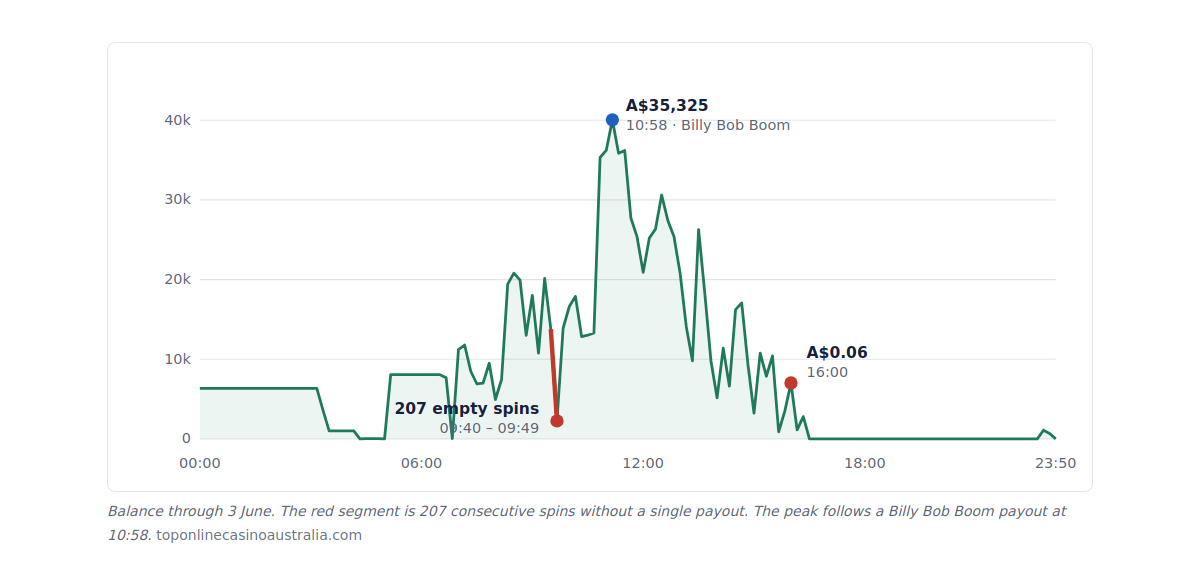

When the wins come, they are big enough to feel like a change of luck. The second log has at least five spins above A$50,000 with a stated bet of A$40 to A$75, each a multiplier past 1,000×. The first log has a 2,065× spin. In the second log the rare huge payouts came with seven empty spins in ten, and neither account ended ahead.
Can you win on pokies: a day, a month, a year
A day: yes. The first account closed 10 of its 57 playing days in profit, two of them by more than A$80,000: 1 August 2025 (+A$81,530) and 23 May 2026 (+A$112,239). The second account started 17 May 2024 with A$508 and had a balance of A$118,413 at the end of 18–19 May. A winning day says nothing about the next one.
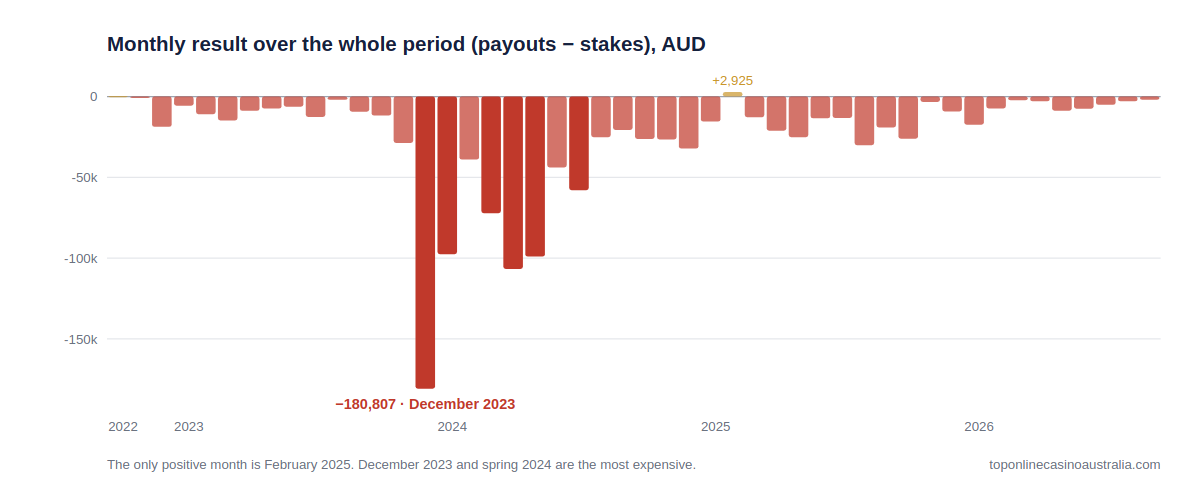
A month: almost never. The second log covers 48 months with play. Only February 2025 closed clearly in profit, by A$2,925. April 2022 was a part month (from 24 April) and roughly break-even. Our chart shows about +A$700; the story's text calls February 2025 the only positive month. We cannot settle this without the original export. The worst month, December 2023, lost A$180,807.
A year: no. The first account lost A$92,027 over fourteen months despite a A$144,550 spin. The second lost between A$19,111 and A$647,192 in every calendar year it played (2022 and 2026 are part years).

Behind this is a simple pattern: a big win does not leave the account by itself. On 23 May 2026 the first player had A$160,050 at 14:09 and played on until after midnight. The day's result, +A$112,239, was still the best in the log, but the balance at the end of the session was A$88,177.
Over fourteen months that account took in about A$951,600 in deposits and paid out about A$850,200 in withdrawals. The second account deposited roughly A$1.49 million and withdrew about A$307,000. All four deposit and withdrawal figures are estimates from gaps in the balance.
Why you lose so much at a 96% return, and what an hour costs
A 96 per cent return is an average over millions of spins. On your money it works like a fee on everything you stake: expected loss = stake × spins × (1 − return). The two accounts returned 95.8 per cent, so they lost about 4.2 per cent of A$31.26 million, which is A$1.30 million. The percentage was ordinary. The volume was not.
| Stake per spin | Spins in the hour | Staked in the hour | Expected loss |
|---|---|---|---|
| A$1 | 1,500 | A$1,500 | about A$60 |
| A$5 | 1,500 | A$7,500 | about A$300 |
| A$75 (the ceiling in both logs) | 1,500 | A$112,500 | about A$4,500 |
These are averages, not the result of any particular hour: one hour can end far up or far down, as the section above shows. Slower play loses less, and a typical player's pace is unknown, so use your own pace: at 500 spins an hour and A$1 a spin, the same sum gives about A$20.
Pace matters for another reason too; the Victorian regulator warns that “Fast spins can lead to impulsive gambling.”
What “strategies” look like in a real log
Neither player followed a betting system in the textbook sense. What they did follow shows up clearly in the data.
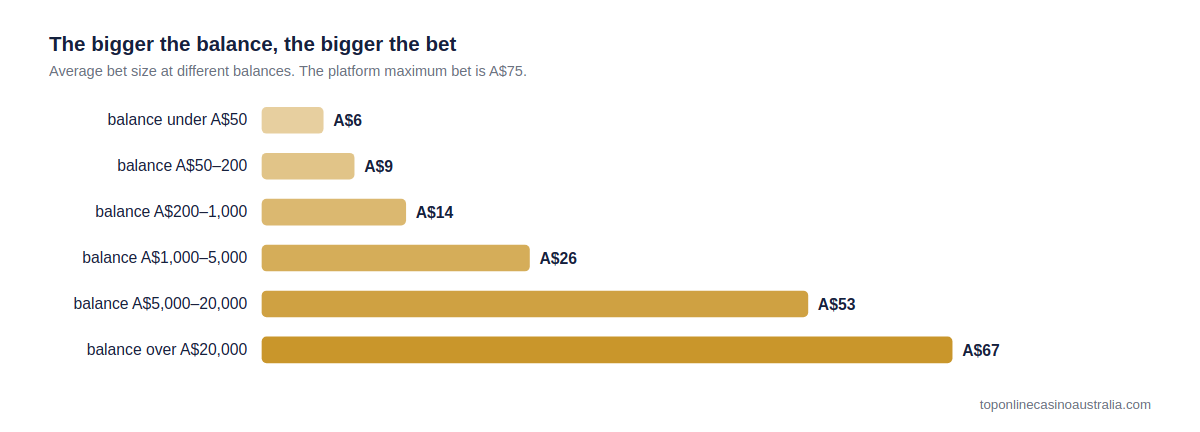
The bet follows the balance. In the second log the average stake was A$6 with under A$50 in the account, A$14 with A$200 to A$1,000, A$53 with A$5,000 to A$20,000 and A$67 above that. The correlation between the balance before a spin and the size of the bet is 0.58. A win did not get banked; it raised the stake, which raised the turnover, which raised the expected loss.

No reaction to losing. The stake after a losing spin averaged A$27.60; after a winning spin, A$27.70. No doubling to chase, no caution after a hit. The losses came from volume: the first player's median pause between spins was 2.3 seconds and the longest session ran 14 hours without a break; what that pace costs is in the hour table.
Switching games. The first player used 337 different pokies in fourteen months; the second used 59, with four of them taking three quarters of all bets. The two best games in the first log (Blast the Bass and Gold Power Express) returned A$302,350 net; the other 335 lost A$394,377. Switching spread the same kind of bets across more games; it did not stop the account losing.
Topping up. The second account made around 4,000 deposits with a median of A$250, including 36 on a single day, 9 May 2024. Small, frequent deposits are how A$1.49 million goes into an account without ever feeling like A$1.49 million.
Popular pokie tips, checked against the logs
Six common tips, from “bet max” to the “$20 method”, each with what it actually changes. None of them turns the expected result into a profit.
- Bet max to win big. Changes: the size of a win, not the odds. Larger stakes mean larger payouts in dollars when a win lands: at least five spins above A$50,000 in the second log came on A$40 to A$75 bets. They also mean larger turnover, and expected loss grows with turnover. Queensland's gambling help service, writing about poker machines, lists “How much you bet” among the factors it says will not make a difference.
- Switch to a hot, loose or “due” pokie. Changes: nothing. New South Wales, Queensland and Victoria all list hot or due machines as a myth. The first player switched games five times during a 207-spin run without a payout; the run went on.
- Leave a game once it has paid, because it tightens. Changes: nothing in these logs. Both accounts had more large wins within a week or two of their biggest ones; the dates are in the section on fairness. Leaving the game changes nothing; leaving with the win withdrawn is different: see the five things that change the result.
- Play high-return (RTP) games. Changes: how fast you lose, not whether. A 97 per cent game loses a third less than a 95.5 per cent game over the same turnover (3 cents against 4.5 cents a dollar), and it still loses.
- Play at a certain time of day. Changes: nothing. Queensland's gambling help service, writing about poker machines, lists “The time of day” among the factors it says will not make a difference. Three large wins in our logs landed at 14:09 (A$144,550), 17:09 (A$78,225) and 10:58 (almost A$30,000) on different days: three examples, not a pattern.
- The “$20 method”. Changes: how much you spend, not what a spin returns. Guides describe it differently. In one American affiliate guide (Gambling Nerd, 17 May 2026) it is a single US$20 session at bets of 20 US cents or less, cashed out once the balance doubles to US$40. Other guides describe other versions. Every version is a spending limit, and the same guide says the method is not a cheat code.
What the logs say about fairness, and what they cannot show
How pokies are tested and what a test certificate covers is explained in how pokies work and who tests them. A bet log cannot audit a random number generator. It can show two narrower things: what share of the money staked came back, and what happened after a big win.
Return. The two accounts got back 98.8 and 94.9 per cent of turnover, 95.8 per cent combined. That is a measured outcome; we did not compare it with each game's certified return.
After a big win. After the A$144,550 spin on 23 May 2026 the same account won A$71,135 on one spin two days later, A$42,840 a week later and A$46,100 a fortnight later. After the A$79,950 spin on 10 May 2024 the second account won A$78,225 a week later. The games kept paying large amounts after large wins; these are examples, not a statistical test. The account that won A$144,550 still ended its fourteen months at A$0.14.
What the logs cannot show. Whether a specific game's actual return matches its certificate, whether the operator is licensed, or whether withdrawals are paid. We cover licensing and payout speed in the casino reviews and in withdrawal times.
The five things that actually change the result
None of these makes pokies profitable. They decide how quickly and how much you lose, and whether a win ever leaves the account.
- Stake times spins. Expected loss is turnover multiplied by the house edge; halving the stake or the session halves it (what an hour costs).
- Withdraw when ahead, and do not deposit it again. The second account's one genuinely large withdrawal in four and a half years was A$72,000, in December 2023. The first account withdrew about A$850,200 and deposited about A$951,600 (estimates), so over the fourteen months more went in than came out. A withdrawal that is deposited again the next day is not a withdrawal.
- Published return matters, a little. A 97 per cent game loses a third less than a 95.5 per cent game over the same turnover. It does not change the sign. Our list of highest-return pokies gives the certified figures.
- Bonuses with wagering conditions add turnover. For example, a bonus that must be wagered 40 times means extra bets worth 40 times its value, all at the house edge. The terms explained page shows how to price one.
- Limits set before the session, not during it. In the second log the average bet was A$67 with over A$20,000 in the account and A$6 with under A$50: stakes rose with the balance. A limit set in advance works against that. Our support resources page compares the gambling blocks of four Australian banks and lists device blockers and helplines.
Questions people ask
Is there a strategy to beat the pokies?
No. The gambling help services of New South Wales and Queensland and the Victorian regulator all say so; Queensland's words are “There is no strategy for winning on a poker machine.” Across a million real spins, two accounts got back 95.8 per cent of what they staked.
What you can change is how much you stake: smaller stakes and shorter sessions lose less, and a win is kept only if it is withdrawn and not deposited again.
Do pokies pay more at certain times of day?
No. Queensland's gambling help service, writing about poker machines, lists “The time of day” among the factors it says will not make a difference. In our two logs, three large wins landed at 14:09 (A$144,550), 17:09 (A$78,225) and 10:58 (almost A$30,000) on different days: three examples, not a pattern.
Does switching games after a losing streak help?
No. The first player switched games five times during a run of 207 spins without a payout, and the run went on. Over fourteen months that player used 337 different pokies; two of them ended A$302,350 ahead and the other 335 lost A$394,377.
Is a big win due after a long losing streak?
No. New South Wales, Queensland and Victoria all call a “due” machine a myth; Victoria's regulator writes that there is no pattern, cycle or “due win”. In the first log the 207 empty spins on 3 June 2026 were followed an hour later by a spin paying almost A$30,000, and that day was still the account's worst: −A$89,065.
Do online pokies pay better than pub pokies?
These numbers cannot answer that. The state rules for pub, club and casino machines set a minimum over a machine's lifetime. In New South Wales gaming machines are required to return 85 to 92 per cent of all money bet over their lifetime. In Queensland the range is 85 to 92 per cent in clubs and hotels and 85 per cent or higher in casinos. The Victorian regulator says generally around 85 per cent or higher.
These rules are for machines in pubs, clubs and casinos, not online games. The two online logs realised 98.8 and 94.9 per cent, which is an outcome, not a minimum. Either way the return is below 100 per cent, and the faster the play, the more it costs.
How much do pokies players actually lose?
It depends almost entirely on stake and time. The two accounts here lost A$92,027 in fourteen months and A$1.21 million in four and a half years, with bets up to the A$75 ceiling.
At the first log's pace, about 1,500 spins an hour, and a 96 per cent return, an hour a week at A$1 a spin costs about A$60 a week on average; slower play loses less. The table in what an hour costs shows A$5 and A$75 a spin.
What should I do if pokies have stopped being entertainment?
Free, confidential help is available 24/7 at gamblinghelponline.org.au and from the National Gambling Helpline on 1800 858 858. A gambling block in your banking app, a blocking app on your phone or computer and the state self-exclusion programs for pubs, clubs and casinos are described on our support resources page.
18+. Gambling involves real financial risk. This page describes what two real bet logs contain. It is not a method for winning: both accounts it is based on lost money, and the patterns described here are the reasons why.
Sources and method
Two operator bet-log exports (156,168 and 853,447 rows, AUD), analysed spin by spin on 24 September 2026; the original exports are not republished, and the figures on this page come from the published narratives (A$70 on Gold Power Express and Three days on top) and their data files (results by day and month, balance by the hour, bet-size distribution, net result by game), linked at the top of this page. Player result = payouts − stakes. Deposits and withdrawals are reconstructed from balance gaps and are estimates. Return percentages are payouts divided by stakes over the whole period. The share of spins returning nothing and more than the stake is from the second, longer log. The April 2022 monthly figure is read from the published chart. Hourly costs use expected loss = stake × spins × (1 − return), a 96 per cent return and the first log's pace (2.3-second median pause, rounded down to 1,500 spins an hour); they are averages, not results. Venue return rules and the statements that there is no strategy are from GambleAware NSW, Poker machines; Gambling Help Queensland, Gambling facts and myths; and the VGCCC, Understanding poker machines (updated 1 June 2026); all read 23 October 2026. The “$20 method” description is from Gambling Nerd, “What is the $20 method”, a US affiliate guide dated 17 May 2026, read 23 October 2026. The tips section checks each tip only against figures on this page and the three state sources; we read these sources and did not test any tip.